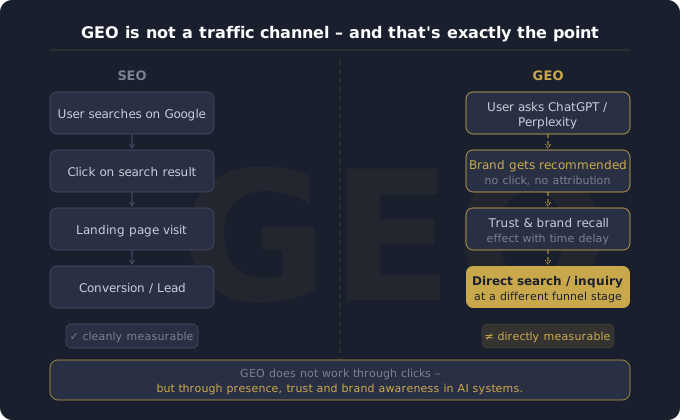
Anyone evaluating GEO by classic performance metrics will be disappointed. No clicks from ChatGPT, no measurable conversions from Perplexity, no clean attribution path. And yet something is happening – just at a different stage in the funnel, and with a time delay.
This article explains why GEO works fundamentally differently from SEO, how you can still recognise its impact, and what that means in practice for different types of websites.
What GEO Is – and What It Is Not
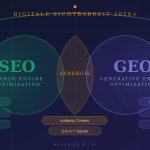
GEO stands for Generative Engine Optimisation. In simple terms, it is about shaping content and brand presence so that large language models (ChatGPT, Perplexity, Gemini, Claude, and others) include you as a relevant source or recommendation when someone asks a fitting question.
The key difference from SEO: with SEO, the user clicks a search result and lands on your page. With GEO, they receive the answer directly from the model – often without any click taking place at all.
GEO is therefore not a performance channel in the sense of CPC, CTR, or direct traffic. There is no click loop to optimise and evaluate daily. Anyone measuring GEO that way is looking for something that simply does not exist there.
But that does not mean GEO achieves nothing. It only means the effect materialises elsewhere.
How Do You Know GEO Is Working?
LLMs do not pass on referrer URLs (with a few exceptions like Perplexity). You cannot see that someone became aware of your brand through ChatGPT. What you can see, when GEO is working:
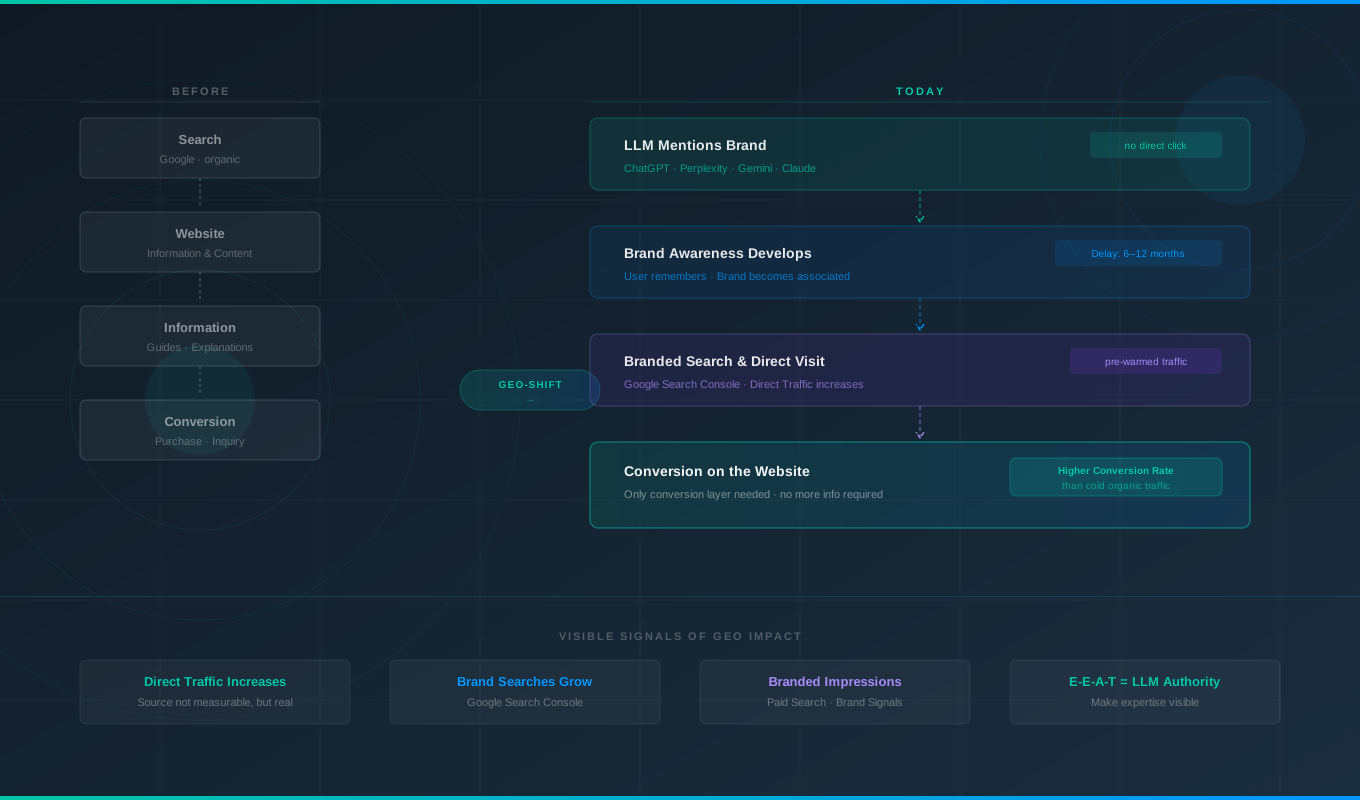
Rise in direct traffic. Users who type your URL directly or visit without a search query often come from a source you cannot see – such as an LLM conversation, a screenshot, or a recommendation.
More brand searches in Google Search Console. When suddenly more people are searching for your brand name without you running a campaign, that is an indicator. The LLM mention created recall that later materialises as a search.
Branded paid search impressions increase. Here too: when more people type your brand name into Google, impressions on brand keywords rise. That is a measurable signal of increased brand awareness.
None of these signals prove GEO impact with absolute certainty. But in combination they paint a clear picture – especially when the rise correlates in time with GEO measures.
The Time Delay: Why the Effect Takes Time to Arrive
GEO impact follows a logic closer to PR or brand advertising than to performance marketing.
The awareness journey looks roughly like this: an LLM mentions your brand in the context of a relevant question, the user files it away, and weeks later they face a genuine need. They then actively search for the brand that was mentioned to them somewhere as a solution – leading to a brand search and ultimately to a conversion.
This is not a direct channel. It is brand building with a delay.
Anyone evaluating GEO measures after four weeks will see nothing. Anyone looking after six to twelve months while observing brand traffic and direct visits will be able to recognise the connection.
E-E-A-T and Why LLMs Use Similar Signals to Google
Google’s E-E-A-T concept (Experience, Expertise, Authoritativeness, Trustworthiness) has been well known in SEO for years. What many have not yet considered: LLMs orient themselves by very similar quality signals when deciding which sources to treat as trustworthy.
Content that demonstrates verifiable expertise – through original studies, clear authorship, consistent thematic depth, and citations from reputable sources – is used more frequently by language models as a reference. Weak generic content that merely covers keywords does not end up in LLM answers.
For GEO practice this means: anyone already consistently optimising for E-E-A-T has a direct head start. Authorship must be recognisable. Content must have a genuine perspective. And the brand must be sufficiently present in its subject area that a language model even considers it as an answer to a question.
Without recognisable authority in a subject area, GEO will not work – just as SEO does not work without substantive content.
How GEO Works for Different Site Types: Guides vs. Transactional Sites
Not all websites face the same challenges. Two broad types can be distinguished:
Guide Sites: The Model Is Now the Competitor
Classic guide content works on a simple principle: user has a question, googles it, lands on the article, becomes a lead or buyer. LLMs structurally attack this mechanism.
“How do I write a meta description?” ChatGPT answers that directly, completely, for free, without a click. The guide article has lost its place in the funnel.
This applies especially to generic informational content without its own perspective. What still works: content with proprietary data, genuine opinion, original research, or an angle that an LLM cannot replicate. But the mass of classic “How does X work” content is losing relevance as a traffic source.
The irony: this content is still used by LLMs – as the basis for answers or for mentions in the right context. It then generates no click, but possibly a brand mention. The effect is not zero, but it looks completely different from before.
Transactional Sites: Traffic Still Comes, But Differently
For websites where a transaction ultimately takes place – purchase, booking, enquiry, or registration – the picture is more nuanced.
LLMs rarely recommend directly with a call to action. They name categories, describe solution approaches, and mention brands that are known in a particular area. The user who subsequently searches actively for a brand is no longer a cold prospect. They have already been pre-qualified.
The new funnel looks roughly like this: LLM mention leads to brand awareness, from which follows a branded search or direct URL entry, and at the end stands the conversion on the website.
The website thereby becomes a pure conversion layer. No longer the place where information is conveyed – that is increasingly taken over by the model – but the place where warmed-up interest becomes a concrete conclusion.
And that has a measurable effect on traffic quality: users who come via an LLM recommendation or the resulting brand search generally have a significantly higher conversion rate than cold organic traffic. They do not arrive by chance; they arrive because they received a concrete recommendation and are searching deliberately. This makes such traffic harder to measure, but more valuable than many other sources.
This has direct consequences for UX and CRO: someone arriving via brand traffic does not need a long explanation page. They need trust, clarity, and a direct path to conversion.
What Is Changing Structurally – and What It Means
The distribution of roles is clearly shifting.
Previously, the path led from search via website to information and then to conversion. Today it runs via the LLM, which creates brand awareness, then on to brand search, and finally to conversion on the website.
That sounds like more effort for the same result. In a sense that is true. But for brands with genuine content authority, an advantage emerges: anyone mentioned by the LLM already has a trust advantage before the user visits the website.
The consequences for content strategy are clear: fewer explanatory pieces that the model will handle anyway. More content that positions a brand, shows a perspective, and builds authority in a subject area. And stronger investment in brand SEO, because brand searches increase when GEO is working.
Conclusion
GEO is not a channel you can neatly justify in the next quarterly review. There are no direct clicks, no clear attribution, no measurable funnel in real time.
What there is: a quiet presence in the answers your target audience receives every day. A brand mention that eventually becomes a brand search. And a user who then lands on your website – already informed, already half convinced, and ready for conversion.
The click does come. Just later, and through a different door.
Anyone who understands this and treats GEO as a long-term brand investment rather than a short-term traffic lever is better positioned than everyone still banking on generic guide articles and wondering why their traffic is disappearing.