Poor content causes double damage: it fails to convince the reader – and it fails to convince Google. Especially in international SEO, text quality is an often underestimated success factor. An article written by a native speaker differs fundamentally from a machine translation – and both the reader and Google's algorithm notice this.
Google E-E-A-T: Experience Is Visible
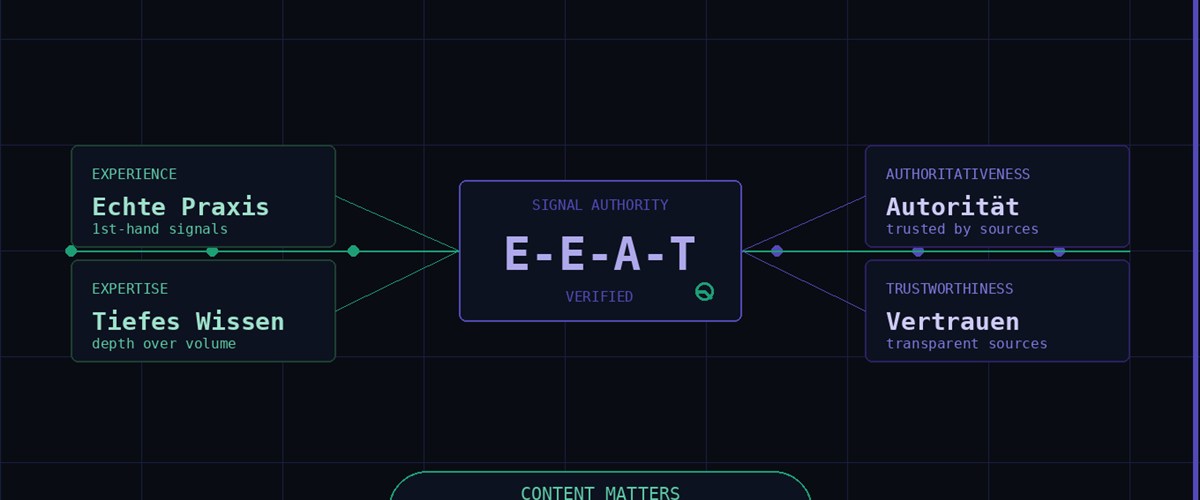
Since the E-E-A-T extension (Experience, Expertise, Authoritativeness, Trustworthiness), Google no longer evaluates content only on keywords and structure, but on recognisable practical experience. Native speakers write idiomatically correctly, use industry language naturally and know local contexts, references and cultural nuances. This difference is measurable for Google's algorithm – and immediately perceptible to the reader.
Especially in sensitive areas such as medicine, law, finance or technology, authentic expertise is indispensable. AI-generated or poorly translated content in these areas is evaluated particularly critically by Google – and can permanently damage user trust.
User Signals Matter Too
User signals are an indirect but important ranking signal. Studies show: users spend on average 2.5 times longer on pages with high-quality, fluently written content than on pages with poor translations or clunky texts. High dwell time and low bounce rate send Google the signal that the page is relevant and valuable to the user.
Poor content systematically degrades these signals: a user who bounces after a few seconds because the text sounds unnatural or provides irrelevant information harms the ranking long-term – even if the page is technically optimised to perfection. Content quality and technical SEO are not alternatives but must go hand in hand.
No AI tool in the world writes the way a native speaker thinks – and the reader notices exactly that.
Typical Translation Mistakes
In practice, we repeatedly see the same mistakes with machine translations or texts without native editing. Literal translations sound idiomatically wrong and immediately appear unnatural to native speakers – an instant loss of trust. Missing cultural adaptation is another common problem: examples, references and tone that work in the country of origin can seem completely out of place in other markets.
Incorrect keyword usage often arises from 1:1 translation of search terms: the English keyword 'link building' is directly translated to 'Link-Aufbau', even though the German search volume lies with 'Linkbuilding'. AI-generated content without human editing is additionally noticeable through generic formulations and lack of depth – and has been increasingly devalued by Google since 2024.
Practical Tip: Always have finished translations proofread by a native speaker – even if a professional translation is already available. Local technical terms and idiomatic expressions are often what makes the difference.
What Makes High-Quality Content
High-quality content is characterised by several features that together create the complete picture. A clearly structured article architecture with a logical flow helps both the reader and the crawler to understand and evaluate the content. Authentic voice and author perspective make the difference between a generic text and an article that one reads willingly to the end.
Local references, examples and cultural context are what truly anchors an international text locally. Precise keyword integration without over-optimisation requires that the author truly masters the language of the target audience. And ultimately correct language feel – fluent reading flow, correct grammar, natural sentence structure – is the basic prerequisite for any text that is meant to rank and convert.
Our Approach at Working Digital
At Working Digital, we work exclusively with native speakers – in all markets where we operate. Every article is written by an editor with industry knowledge, not translated. This means: the text is created directly in the target language, with knowledge of local search habits, industry language and cultural particularities.
This approach is more labour-intensive and cost-intensive than using translation tools or generative AI systems. But it consistently pays off: in the form of better rankings, longer dwell times, more credible placements and ultimately more conversions. Our clients see the difference in the numbers.
Conclusion
In a world increasingly flooded with AI-generated content, authentic, high-quality native speaker content is a genuine competitive advantage. Google recognises and rewards this difference – and your users do too. Invest in quality: your rankings will reflect it.