Search is fundamentally changing. More and more people are no longer asking their questions in classic search engines, but directly to AI systems like ChatGPT, Perplexity AI or Google's AI Overviews. A new discipline is emerging: Generative Engine Optimization – GEO for short. Anyone who wants to be visible in AI answers today needs a new strategy.
What is GEO – Generative Engine Optimization?
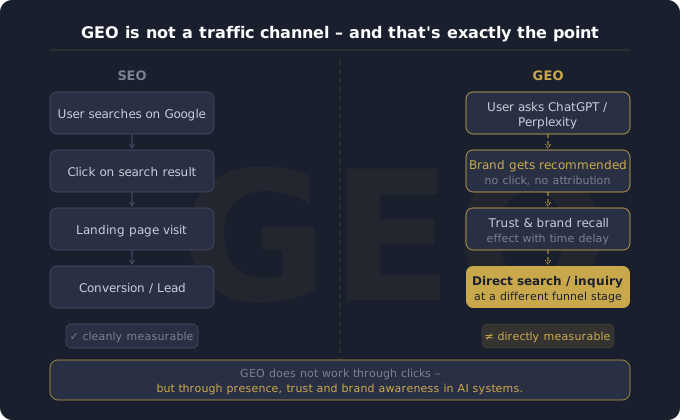
GEO describes all measures aimed at placing your own content in the outputs of AI-powered search systems. Unlike classic SEO, which targets clicks and rankings in search result lists, GEO is about being recognised, cited and recommended by AI models as a reliable source.
The most important AI search systems you should optimise for:
- Google AI Overviews (formerly Search Generative Experience)
- ChatGPT Search (OpenAI)
- Perplexity AI
- Microsoft Copilot / Bing AI
- Claude (Anthropic) with web search
Why GEO Is Becoming Relevant for SEO Agencies Now
According to current studies, over 30% of those under 35 already use AI assistants as their primary information source for complex questions. For niches with high information density – B2B, law, health, finance, technology – this share is even higher. Those who don't appear in these AI answers lose visibility without noticing it in Google Analytics.
GEO is not a replacement for SEO – it is the logical extension of it. Those who write for people and algorithms today must also write for AI models tomorrow.
The 6 Most Important GEO Factors
1. Authority and E-E-A-T
AI models prefer sources that are classified as trustworthy and authoritative. This corresponds to Google's E-E-A-T concept (Experience, Expertise, Authoritativeness, Trustworthiness) – applied to AI training data and real-time web search. Articles with a clearly identifiable author, source references and demonstrable expertise are cited significantly more often.
2. Structured, Directly Usable Answers
AI systems extract answers from clearly structured texts. Short, concise answers to specific questions at the beginning of a section, followed by in-depth explanations, significantly increase the probability of citation. Use FAQ sections, definition boxes and numbered lists.
3. Backlinks as a Trust Signal
AI models that search the web in real time (like Perplexity or ChatGPT Search) use backlinks as a quality signal – just like Google. Pages with a strong backlink profile are classified as more reliable sources and more frequently included in AI answers. GEO and classic link building thus directly complement each other.
Working Digital Insight: Our experience shows: websites with a strong, natural backlink profile are cited significantly more frequently as sources in AI search systems. Link building is therefore not just an SEO lever – but also a direct GEO factor.
4. Semantic Depth Instead of Keyword Density
AI models understand topics holistically, not keyword-based. Content that illuminates a topic from multiple perspectives, explains related concepts and demonstrates genuine expertise ranks better in AI outputs than superficially optimised texts. Write for the expert, not for the search engine crawler.
5. Structured Data (Schema Markup)
Schema markup helps AI systems understand the context and type of your content. FAQ-Page, HowTo, Article and Organisation schema are particularly relevant for GEO. They make it easier for AI models to correctly classify your content and cite it in appropriate answer contexts.
6. Citability Through Statistics and Studies
AI answers need evidence. Content that contains concrete figures, studies or original data is preferentially used by AI systems as sources – because it increases the quality of answers. Invest in your own studies, surveys or data-based analyses to qualify as a citable primary source.
GEO Checklist: 10 Measures for Immediate Implementation
- Add author profiles to all important content pages
- Add FAQ sections with direct answers
- Implement schema markup (Article, FAQ, Organisation)
- Build internal link structure semantically
- Strengthen backlink profile through high-quality link building
- Publish own studies, data and statistics
- Enrich content with concrete definitions and explanations
- Ensure crawlability (no blockers for AI bots)
- Include quotes, expert opinions and external references
- Regularly update content (freshness as a quality signal)
GEO vs. SEO: What Stays the Same, What Changes?
The good news: those who do classic SEO correctly have already laid a large part of the GEO foundations. Technical SEO, high-quality content, strong backlinks and E-E-A-T are relevant for both Google rankings and AI visibility. The crucial difference lies in content structure: AI models prefer clearly answering, semantically dense content over keyword-optimised but content-thin texts.
Conclusion: GEO Is the Future of Search Engine Optimisation
AI search engines are not a passing trend – they are the next evolutionary stage of search. Those who start now to optimise their content for AI systems are securing a decisive competitive advantage. The fundamentals are the same as in SEO: quality, authority and relevance. The scope of application is simply expanding.
Would you like to set up your GEO and SEO strategy holistically? Working Digital supports you with over 15 years of experience and an international network – from classic link building to modern AI visibility.